Key Takeaway
- Learning = minimizing the cost function by nudging every weight and bias in the direction that reduces cost
- That direction is given by the negative gradient
- Backpropagation is how we compute that gradient efficiently
This chapter answers:
How does a neural network actually learn?
Introduce
Learning in neural networks = adjusting weights and biases to make predictions less wrong.
- This chapter: how the network updates parameters.
- Core idea: Gradient Descent.
Two Main Goals of This Video
- Understand the intuition of gradient descent.
- Connect that intuition to neural network parameters (all weights and biases).
What Should Learning Optimize?
We need one number that says “how bad the network currently is”.
- This number is called the cost (or loss over dataset).
- If cost is high, predictions are bad.
- If cost is low, predictions are better.
Cost Function (Simple Form)
A cost function is a mathematical formula used to measure how wrong a model’s predictions are.
Neural Network function:
- Input: 784 pixels
- Output: 10 numbers (0~9)
- Parameters: 13,002 (weights/bias)
Cost function is:
- Input: 13,002 (weights/bias)
- Output: 1 number (the cost)
- Parameters: many, many, many training examples
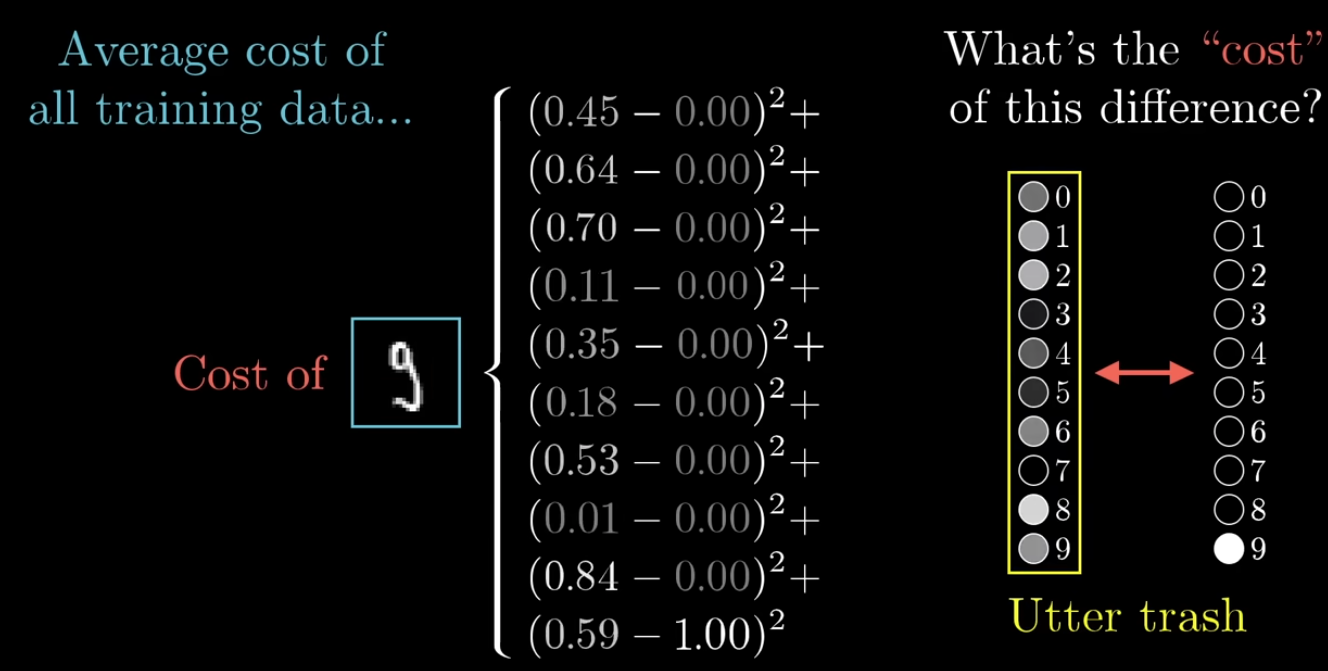
For one training example:
- : output activation of neuron
- : target value of neuron
- Squaring has two main purposes:
- It prevents positive and negative errors from canceling each other out
- It penalizes larger errors more heavily
Cost Function = Average loss over all training examples
- average:
- sum all training set:
- is the average error over the training set.
- Learning goal: make as small as possible.
Find the min cost point of cost function
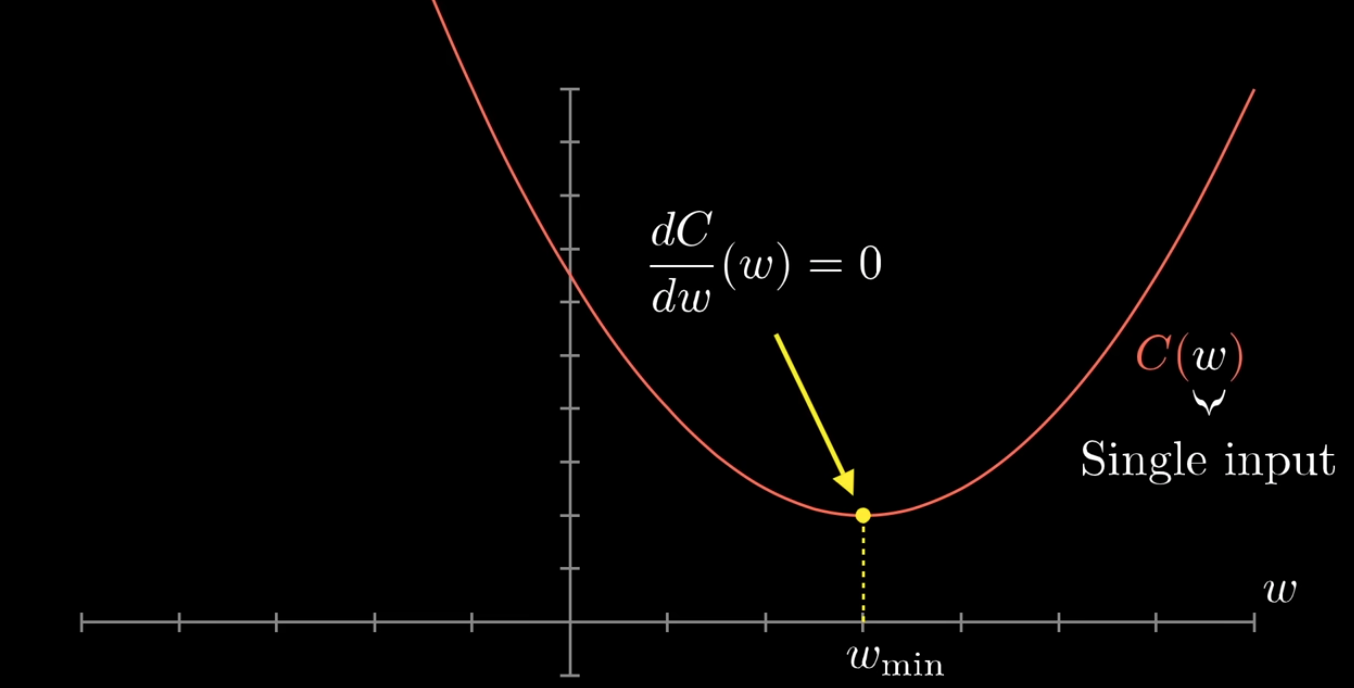
- Cost Function Curve for a Single Weight
Explain derivative
-
Derivative = the instantaneous rate of change of a function.
-
Cost function as
C(w)because different values ofwproduce different cost values;- compute the derivative to see whether the cost is increasing or decreasing at the current
w - and use that slope information to adjust
wstep by step untilC(w)gets closer to its minimum.
- compute the derivative to see whether the cost is increasing or decreasing at the current
-
The figure labels:
- This means: is the derivative of
C(w)with respect tow - the derivative tells us the slope of the curve
- at the minimum point, the curve is flat
- This means: is the derivative of
-
so the slope is zero, at the bottom of the curve.
Gradient Descent
Imagine the cost function as a landscape (hills and valleys). We want to move downhill.
Gradient descent (∇ = gradient symbol):
- is the method the model uses to learn.
- It works by repeatedly adjusting the parameters (weights and biases) a little bit so that the cost function becomes smaller.
- At each step, it looks at the gradient, which tells how the cost changes with respect to each parameter, and then moves the parameters in the opposite direction of that gradient.
- Parameters (all weights + biases) are coordinates in a high-dimensional space.
- At current position, compute the slope direction that increases cost fastest.
- Move in the opposite direction to decrease cost fastest.
Update Rule
If parameter vector is :
New parameters = old parameters - a small step opposite to the gradient.
- Symbols mean:
- θ: parameter
- : cost function
- : gradient vector (all partial derivatives)
- : learning rate (step size)
- the model adjusts its parameters a little bit each step in order to reduce the cost.
For each parameter separately:
new value = old value - learning rate × the partial derivative of the cost with respect to that parameter
Why Gradient?
- Gradient points to steepest increase of the function.
- Negative gradient points to steepest decrease.
- So using is the most efficient local direction to reduce cost.
Learning Rate (η)
Links: What is Gradient Descent - GeeksforGeeks
- Learning rate is a important hyperparameter in gradient descent
- that controls how big or small the steps should be when going downwards in gradient for updating models parameters.
- It is essential to determines how quickly or slowly the algorithm converges toward minimum of cost function.
- If Learning Rate too small:
- Learning is very slow.
- If Learning Rate too large:
- May overshoot and bounce around, or even diverge.
- If Learning Rate too small:
- Practical training needs a reasonable learning rate schedule.
High-Dimensional Perspective
- A small network can already have thousands of parameters.
- Real networks can have millions or billions.
- We cannot visualize this space directly, but gradient descent still applies mathematically.
Why Random Initialization?
- If all weights start the same, many neurons stay symmetric and learn the same thing.
- Random initialization breaks symmetry.
- Then different neurons can learn different useful features.
Example
Example 1: One-Parameter Gradient Descent
-
Suppose:
-
Then:
-
Let initial , learning rate .
- Step 1:
- Gradient at
- Update:
- Gradient at
- Step 2:
- Gradient at
- Update:
- Gradient at
- Step 1:
-
You can see gradually moves toward 3, where cost is minimal.
-
Update formula stays the same no matter whether the slope is negative or positive;
- only the direction of the update changes.
- if , so
wdoes not change, and it may mean we have already reached the minimum point.
Example 2: Network Parameter Update (Conceptual)
- Suppose one weight has derivative .
- If :
- If the derivative is positive, increasing increases the cost, so we move smaller.
- If the derivative is negative, increasing decreases the cost, so we move larger.
Summary
- Neural network learning is an optimization problem.
- Define cost, compute gradients, update parameters repeatedly.
- Gradient descent is the core engine behind this process.
- Chapter 2 builds the optimization intuition; Chapter 3 explains backprop in detail.
Derivative Power rule
Examples: