Designing a Like Feature
A practical system design note for a post like feature, from database modeling to large-scale asynchronous like-count aggregation.
A like feature looks simple, but it is a useful system design example because it touches several common engineering problems:
Data modeling:
How should likes be represented?

Consistency:
How do we prevent duplicate likes?

Performance:
How do we answer common queries quickly?

Scalability:
What happens when there are billions of likes?

Aggregation:
How do we efficiently maintain like counts?

Distributed systems:
How do sharding, CDC, Kafka, and replication fit together?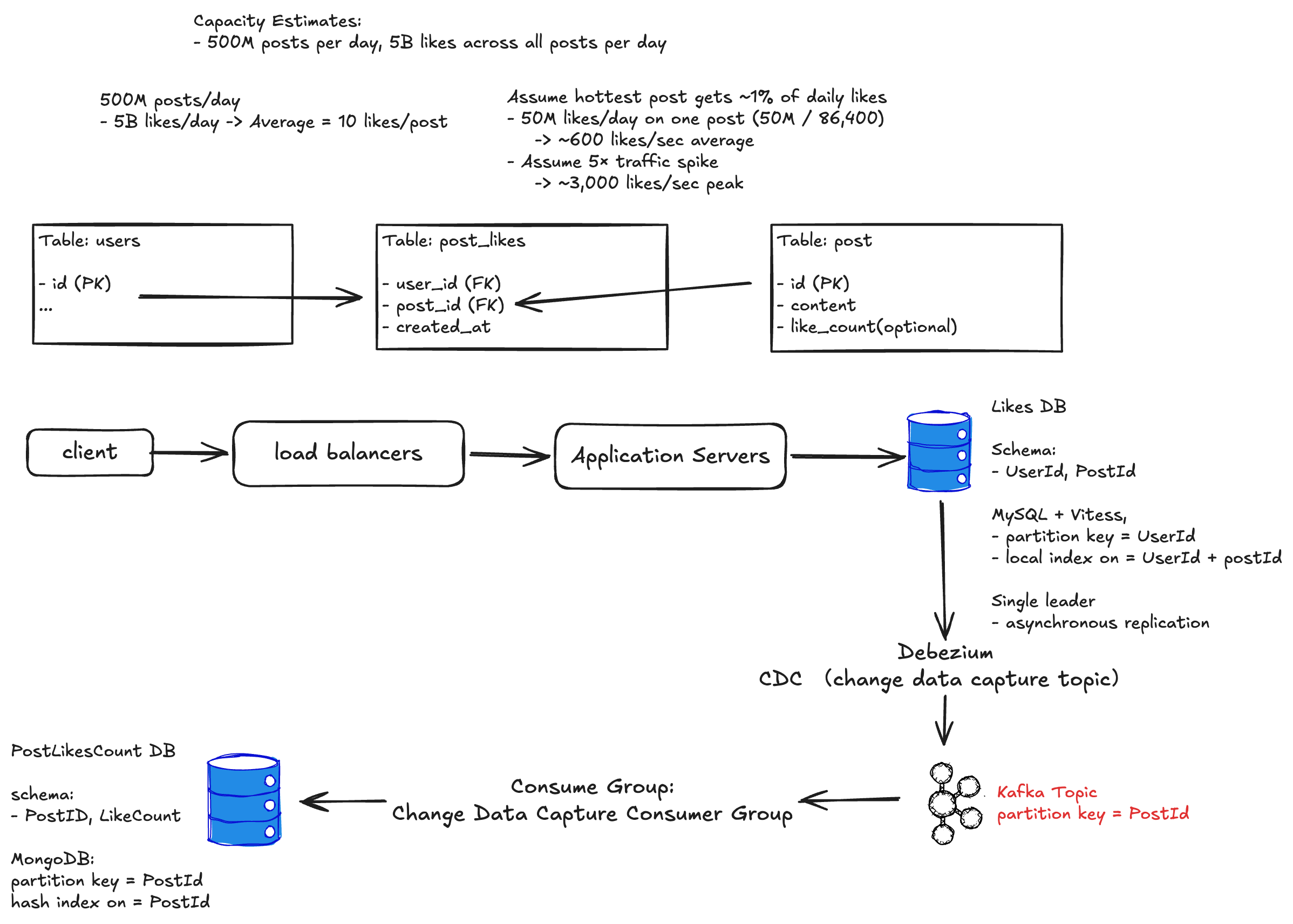
The end-to-end flow drawn above:
Client
↓
Load Balancer
↓
Application Servers
↓
Likes DB
↓
Debezium
↓
Kafka Topic
↓
Consumer Group
↓
PostLikesCount DB
1. Capacity Estimation
Suppose the system handles:
500M posts/day
5B likes/day
Average like write QPS:
5,000,000,000 / 86,400
≈ 57,870
≈ 60,000 likes/sec
So:
Average write QPS ≈ 60K likes/secThe hottest post cannot be derived exactly from total posts and likes, so we need an assumption.
For example, assume the hottest post gets about 1% of all daily likes:
5B × 1%
= 50M likes/day
Average QPS on that one post:
50,000,000 / 86,400
≈ 579
≈ 600 likes/sec
If we assume peak traffic is 5× average:
600 × 5
≈ 3,000 likes/sec
So:
Total traffic:
5B likes/day
→ ~60K likes/sec average

Hot post:
50M likes/day
→ ~600 likes/sec average on one post_id

Peak assumption:
600 × 5
→ ~3,000 likes/sec
Capacity estimation numbers are often assumptions, not exact predictions.
The point is to understand the order of magnitude.
2. Storage Estimation
One like corresponds to one database row.
For rough system design math, assume:
1 like row ≈ 100 bytesThen:
5B likes/day × 100 bytes
= 500B bytes/day
≈ 500 GB/day
This is a back-of-the-envelope storage estimate.
3. Data Modeling
A like is a relationship between a user and a post.
User X likes Post YSo the basic table should represent that relationship directly:
CREATE TABLE post_likes (
  user_id UUID NOT NULL REFERENCES users(id),
  post_id UUID NOT NULL REFERENCES posts(id),
  created_at TIMESTAMP DEFAULT now(),

  PRIMARY KEY (user_id, post_id)
);
Each row means:
(user_id = U1, post_id = P10)
→ user U1 liked post P10
Adding a row means like.
Removing a row means unlike.
DELETE FROM post_likes
WHERE user_id = :user_id
  AND post_id = :post_id;
Do not store an array like this inside posts:
posts
- id
- content
- liked_user_ids
That makes uniqueness, querying, indexing, and scaling harder.
4. Why the Composite Primary Key Matters
The important part is:
PRIMARY KEY (user_id, post_id)The table is not automatically deduplicated just because it is a separate table.
The composite primary key enforces uniqueness:
(U1, P1) ✅
(U1, P2) ✅
(U2, P1) ✅
(U1, P1) ❌ duplicate
So one user can like one post only once.
The entire pair:
(user_id, post_id)is the primary key.
user_id is not one primary key and post_id another. Together they form one composite primary key.
5. Idempotent Like and Unlike
Do not rely only on application-level check-then-insert logic:
if not exists_like(user_id, post_id):
    insert_like(user_id, post_id)
Concurrent requests can create a race condition:
Request A checks → no like
Request B checks → no like
Request A inserts
Request B inserts
The database should enforce the rule.
In PostgreSQL:
INSERT INTO post_likes (user_id, post_id)
VALUES (:user_id, :post_id)
ON CONFLICT (user_id, post_id) DO NOTHING;
The placeholders:
:user_id
:post_id
are values supplied by the backend at execution time.
For example:
:user_id → U1
:post_id → P100
ON CONFLICT ... DO NOTHING means:
First like  → insert row
Second like → do nothing
Third like  → do nothing
So repeated requests result in the same final state.
That makes the operation idempotent.
Unlike can also be idempotent:
DELETE FROM post_likes
WHERE user_id = :user_id
  AND post_id = :post_id;
Deleting a row that does not exist simply changes nothing.
6. Indexes Follow Query Patterns
Typical queries include:
1. Did this user like this post?
2. Which posts did this user like?
3. Who liked this post?
4. How many likes does this post have?
The composite primary key:
PRIMARY KEY (user_id, post_id)also gives an index ordered by:
user_id → post_idIt works well for:
WHERE user_id = ?and:
WHERE user_id = ?
  AND post_id = ?
For example:
SELECT 1
FROM post_likes
WHERE user_id = :user_id
  AND post_id = :post_id;
or:
SELECT post_id
FROM post_likes
WHERE user_id = :user_id;
Leftmost Prefix Rule
For an index:
(user_id, post_id)the database can efficiently use the leftmost part:
user_idor:
user_id + post_idbut not usually post_id alone.
So this query needs another index if it is common:
SELECT user_id
FROM post_likes
WHERE post_id = :post_id;
Create:
CREATE INDEX idx_post_likes_post_id
ON post_likes(post_id);
Its job is simple:
Create a separate index on
post_idin thepost_likestable to make queries that look up likes by post faster.
You normally do not mention the index name in normal queries.
Write:
SELECT user_id
FROM post_likes
WHERE post_id = :post_id;
and let the query optimizer decide which index to use.
The index name is mainly for administration:
DROP INDEX idx_post_likes_post_id;Important
Indexes are not free.
Every additional index:
- consumes storage
- increases insert cost
- increases delete cost
- increases update cost
So the rule is:
Design indexes around real query patterns, not around every column.
7. Counting Likes
At small or medium scale:
SELECT COUNT(*)
FROM post_likes
WHERE post_id = :post_id;
can be perfectly reasonable, especially with:
INDEX(post_id)The index prevents a full-table scan.
However, an index only helps the database find the matching rows.
It does not automatically make counting millions of matching rows free.
For example:
post P100 has 50,000,000 likesThe index can quickly locate the relevant range, but COUNT(*) may still need to process a huge number of matching entries.
This distinction is important:
INDEX(post_id)
→ quickly find likes for a post

precomputed like_count
→ directly read the total number of likes
8. Precomputed Like Count
For read-heavy systems, maintain a separate counter:
post_like_counts

post_id | like_count
--------|-----------
P10     | 50,000,000
or optionally:
posts
- id
- content
- like_count
Then reads become:
SELECT like_count
FROM post_like_counts
WHERE post_id = :post_id;
instead of counting raw rows every time.
The tradeoff is consistency.
The source of truth is still:
post_likeswhile:
like_countis derived data.
Possible inconsistency:
post_likes contains 1001 likes
like_count temporarily shows 1000
9. Synchronous vs Asynchronous Counter Updates
A simpler design updates both synchronously:
User likes post
↓
Insert into post_likes
↓
Increment like_count
↓
Return success
At larger scale, this adds more work to the request path.
A more scalable design moves count aggregation to the background:
User likes post
↓
Likes DB
↓
CDC
↓
Kafka
↓
Consumer Group
↓
PostLikesCount DB
This introduces eventual consistency, but removes counter maintenance from the main request path.
10. Sharding the Likes Database
At very large scale, a single MySQL instance is not enough.
One possible design is:
Application
↓
Vitess
↓
MySQL shards
MySQL
MySQL stores the actual data.
Vitess
Vitess is an open-source system that manages sharded MySQL clusters.
A useful mental model:
MySQL = stores the data
Vitess = manages and routes across many MySQL shards
For checking:
Has user X liked post Y?we may shard by:
user_idThen:
user_id
↓
find the correct shard
↓
local index (user_id, post_id)
↓
find the exact like row
The distinction is:
Shard key tells us which database to query.
Index tells that database where inside the database to find the row.
Example
Shard key:
user_id

Local index:
(user_id, post_id)
This is efficient for:
Has user U liked post P?
Which posts has user U liked?
But a query by post_id alone may require a scatter-gather query across shards.
This is the shard-key tradeoff.
11. Single Leader and Asynchronous Replication
A database shard may use:
Single leader
+
asynchronous replication
Single leader means:
Writes → Leader
Reads  → Leader or Replicas
The leader accepts writes and then replicates them to followers.
With asynchronous replication:
Client writes
↓
Leader commits
↓
Client may receive success
↓
Replicas catch up later
This can create replication lag.
For example:
Leader:
U1 liked P10 ✅

Replica:
not updated yet ❌
If the system immediately reads from the stale replica, it may temporarily return the wrong result.
That is a read-after-write consistency issue.
12. CDC with Debezium
CDC means:
Change Data CaptureDebezium is a CDC tool.
It monitors database changes, often through the database transaction log.
For MySQL, this commonly means reading the binlog.
Example:
MySQL INSERT:
(U1, P10)
Debezium detects the change and converts it into an event.
The flow is:
Likes DB
↓
Debezium
↓
Kafka Topic
Important distinction:
Debezium detects database changes.
Kafka stores and distributes the resulting events.
Kafka itself does not detect MySQL changes.
13. Kafka and the Consumer Group
Picking up the flow shown at the top of this post:
The Likes DB stores:
(user_id, post_id)The PostLikesCount DB stores:
(post_id, like_count)The consumer reads like/unlike events and updates the aggregate count.
Example:
Kafka event:
U1 liked P10

Consumer:
P10.like_count += 1
A consumer group allows multiple consumers to process different Kafka partitions in parallel.
The consumers can remain stateless because the durable state lives in the database.
14. Why Use a Separate Count Database?
The two databases optimize different access patterns.
Likes DB
Schema:
(user_id, post_id)

Main questions:
- Has user X liked post Y?
- Which posts has user X liked?
A relational database such as MySQL works naturally here.
PostLikesCount DB
Schema:
(post_id, like_count)

Main question:
- How many likes does post Y have?
The data model is simple and lookup-oriented.
A document/key-value style store such as MongoDB can be reasonable.
For example:
{
  "post_id": "P10",
  "like_count": 50000000
}
MySQL could also handle this.
MongoDB is a design choice, not a requirement.
The bigger idea is:
Different access patterns may justify different storage models.
15. Kafka Partition Key
The source Likes DB may be sharded by:
user_idbut the Kafka topic does not necessarily need the same partition key.
Suppose Kafka is also partitioned by user_id:
U1 likes P100 → Partition A
U2 likes P100 → Partition B
U3 likes P100 → Partition C
Different consumers may process those events in parallel.
But all of them eventually try to update:
P100.like_countat the same time.
That can create:
lock contention
hot row contention
A better Kafka partition key for count aggregation is often:
post_idThen:
U1 likes P100
U2 likes P100
U3 likes P100
all go to the same Kafka partition.
That preserves ordering for one post and avoids multiple consumers simultaneously updating the same post counter.
General rule:
Partition events by the entity whose state is being updated.
This also shows:
Source DB shard key and Kafka partition key do not have to be the same.
16. Exactly-Once and Duplicate Processing
Kafka consumers can retry or receive events again.
Suppose:
offset 200 → Like
offset 201 → Unlike
offset 202 → Like
offset 203 → Like
If the consumer processes offset 200, crashes, and later sees it again, blindly doing:
like_count += 1would double-count the event.
One approach is to store the last processed Kafka offset together with the counter:
post_id | like_count | latest_offsetFor example:
P100 | 5000 | 200Then the consumer knows offset 200 has already been processed.
After processing through offset 203:
P100 | new_count | 203The key idea is:
Kafka may redeliver events, so the consumer needs a strategy to avoid double-counting.
The count update and offset update should ideally be atomic.
For a high-level interview answer, understanding the duplicate-processing problem is usually enough. The internal details of Kafka exactly-once semantics can be treated as a deeper follow-up topic.
17. Component Responsibilities
Putting a name on what each piece in that flow is actually responsible for:
Likes DB
→ source of truth for like relationships

Debezium
→ captures database changes

Kafka
→ stores and distributes change events

Consumer Group
→ aggregates like/unlike events

PostLikesCount DB
→ read-optimized count store
18. Design Progression
It is useful to think about the design in levels.
Level 1 — Simple
post_likes
+
INDEX(post_id)
+
COUNT(*) when needed
Good for small and medium systems.
Level 2 — Precomputed Counter
post_likes
+
post_like_counts
Reads become cheap, but the counter must stay synchronized.
Level 3 — Async Aggregation
post_likes
↓
CDC
↓
Kafka
↓
Consumers
↓
post_like_counts
Better for very large write volume and read-heavy workloads.
The tradeoff is eventual consistency.
19. Key Takeaways
- Model a like as a relationship:
(user_id, post_id). - Use a composite primary key to enforce one like per user per post.
- Make like and unlike idempotent.
- Design indexes around query patterns.
(user_id, post_id)is good for user-first queries.- Add
INDEX(post_id)for post-first queries. - Indexes help locate rows, but do not eliminate the cost of counting millions of rows.
- At large scale, precompute
like_count. - Use sharding when one database is no longer enough.
- Shard keys and indexes solve different problems.
- CDC tools such as Debezium capture database changes.
- Kafka distributes those change events.
- Consumer groups asynchronously maintain aggregate counters.
- Kafka partitioning by
post_idhelps preserve per-post ordering and reduce write contention. - Asynchronous aggregation introduces eventual consistency.
- Duplicate event processing must be handled so counters are not incremented twice.
Interview Summary
I would model likes in a separate post_likes table using
(user_id, post_id) as a composite primary key.

This directly represents the many-to-many relationship and
prevents the same user from liking the same post more than once.

For consistency, I would use an idempotent insert such as
INSERT ... ON CONFLICT DO NOTHING instead of relying on a
check-then-insert pattern.

For performance, I would design indexes around access patterns.
The composite primary key supports user-first queries, while an
additional index on post_id supports post-first queries.

At smaller scale, COUNT(*) with an index may be sufficient.
At larger scale, I would maintain a precomputed like_count.

For very large traffic, I would shard the source likes database,
for example by user_id, and asynchronously propagate changes
through CDC and Kafka to a count store keyed by post_id.

The source likes table remains the source of truth, while the
count store is a read-optimized derived view and can be eventually
consistent.