Message Queues: Decoupling Work Without Losing Reliability
A systems note on why asynchronous messaging exists, how queues decouple producers and consumers, and why acknowledgments, persistence, and failover matter.
Message queues look simple from a distance: one system sends work, another system processes it later. The reason they matter is that this small shift changes how systems behave under load, how failures propagate, and how delivery is coordinated.
That is why I think the most useful way to understand a message queue is not as a buffer, but as a coordination layer between producers, consumers, and failure handling.
Why Asynchronous Messaging Exists
Synchronous calls are easy to reason about because everything happens in one request path. A caller makes a request, waits for the response, and then continues. That is fine when the dependency is fast and reliably available.
The trouble starts when the dependency is slow, overloaded, or temporarily down. Now the caller is blocked, latency accumulates, and failure can cascade through the system.
Asynchronous messaging changes the contract:
- the producer hands work to the broker and continues
- the consumer processes the work when it is ready
- producers and consumers no longer need to be tightly coupled in time
The main value is not magic parallelism. It is that the system stays responsive even when downstream work is slower than request handling.
The Four Messaging Primitives
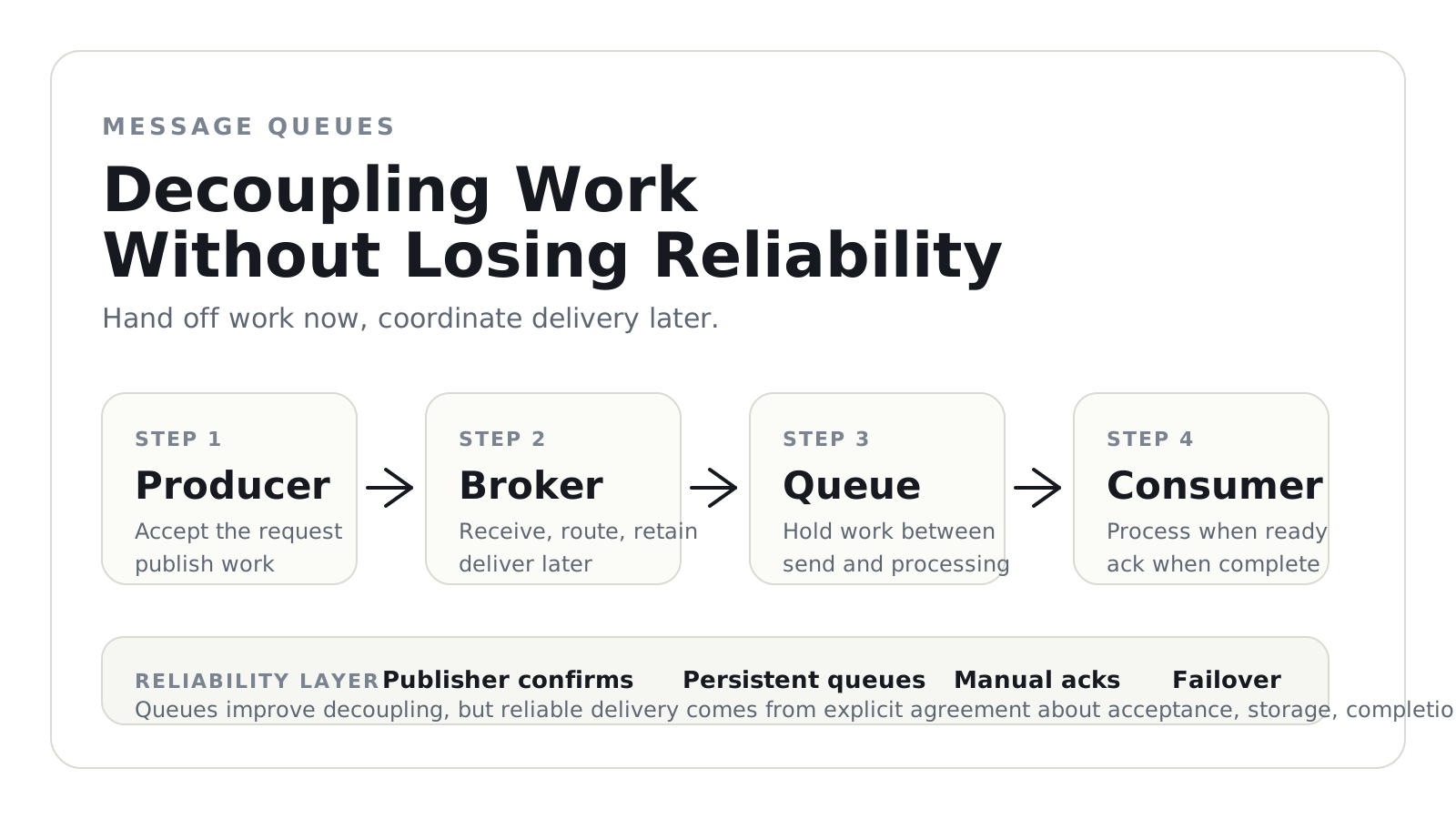
Most messaging systems reduce to four pieces:
Producer: sends a messageBroker: accepts, stores, and delivers messagesQueue: holds messages between send and processingConsumer: receives and processes messages
That structure matters because it separates two concerns that are often coupled in synchronous systems:
- accepting work
- finishing work
Once those concerns are split, the system can absorb bursts more gracefully, but it also has to make explicit decisions about delivery, retries, and failure recovery.
Push vs Pull
One of the first design choices is how consumers receive work.
With polling or pull, the consumer repeatedly asks the broker whether a message is available. The consumer is driving the fetch cycle: "Do you have anything for me now?" This is easy to implement, but it wastes cycles and network traffic when there is nothing to consume.
With push or callback delivery, the consumer first registers interest and then the broker delivers work when messages arrive over that existing consumption relationship. The broker is now driving delivery instead of waiting to be asked again and again.
In practice, push is the more common production model. It avoids empty polling, keeps latency lower for continuously running workers, and usually gives better throughput under normal load.
Polling still has a place, but it is more of a special-case tool:
- simple demos or debugging
- batch-style workers that want strict control over when they fetch
- systems that do not want a continuously active consumer loop
So the practical rule is:
- choose
pushfor normal long-running consumers - choose
pollonly when the consumer really needs to control fetch timing itself
There is one important nuance. Push does not mean the broker should dump unlimited messages onto the consumer. In RabbitMQ, push is normally paired with prefetch, which limits how many unacknowledged messages the broker may have outstanding for a consumer at one time. That is what turns push into a controlled delivery model instead of an uncontrolled flood.
Reliability Comes From More Than The Queue
Using a queue does not automatically make delivery safe. Reliability comes from the combination of multiple safeguards.
There are three common failure points:
- the producer sends a message, but the broker never truly accepts it
- the broker accepts the message, but crashes before the message is durably stored or delivered
- the consumer receives the message, but crashes before processing is actually complete
That is why messaging systems usually need some combination of:
publisher confirms, so the producer knows the broker really accepted the messagepersistent queues and messages, so broker crashes do not erase queued workmanual acknowledgments, so the broker removes work only after the consumer finishes processingprefetch limits, so a consumer is not overwhelmed with more in-flight messages than it can safely handle
This is also the most important mental model in practice: queues improve decoupling, but delivery guarantees come from explicit coordination about when a message is accepted, stored, completed, and allowed to continue flowing to the consumer.
Pub/Sub And When One Consumer Is Not Enough
A basic queue usually gives one message to one consumer. That is good for work distribution, but it is not enough when multiple downstream systems need the same event.
That is where publish-subscribe enters:
- one producer emits an event
- multiple subscribers receive their own copy
- each subscriber processes the message independently
This pattern is useful when the same event should trigger different workflows, such as analytics, notifications, and operational processing. The queue is no longer just distributing load. It is now fanning out information to multiple consumers without forcing the producer to know who all the subscribers are.
The Broker Can Also Fail
Message queues often improve resilience between services, but the broker itself can become a single point of failure if it is not replicated.
That is why high-availability messaging setups introduce:
- a leader handling active I/O
- one or more followers replicating queue state
- automatic failover when the leader becomes unavailable
This improves availability, but it is worth being precise about the tradeoff: replication protects continuity more than throughput. A replicated broker is safer, but it does not automatically make the system process messages faster.
Why RabbitMQ Uses Exchanges
RabbitMQ is a useful example because it makes routing explicit. Producers do not usually publish directly to a queue. They publish to an exchange, and the exchange decides which queue or queues should receive the message.
That extra layer matters because it separates message production from routing policy.
In practice, this enables:
- direct routing for point-to-point delivery
- topic routing for pattern-based delivery
- fanout for broadcast-style delivery
The exchange abstraction is what lets RabbitMQ support both simple queues and more flexible pub/sub patterns without forcing producers to hard-code queue topology.
Key Takeaways
- asynchronous messaging helps systems stay responsive by separating request handling from downstream processing
- a queue is not just storage; it is the coordination point between producers, consumers, and failure handling
- pull means the consumer asks for work, while push means the broker delivers work after consumption has been registered
- push delivery is usually the more common production model, while polling is more of a special-case tool
- end-to-end reliability depends on confirms, persistence, and acknowledgments working together
- in RabbitMQ,
prefetchand manualackare what keep push delivery controlled instead of overwhelming consumers - pub/sub is useful when the same event must reach multiple independent consumers
- broker replication improves availability, but it does not remove the need to think carefully about delivery semantics