LLM Basics: Transformers, Tools, and Agents
Notes on the three transformer architectures, chat templates and special tokens, tool calling and MCP, and the agent Thought/Action/Observation loop.
LLM (Large Language Model): a type of AI model that excels at understanding and generating human language.
3 Types of Transformers
-
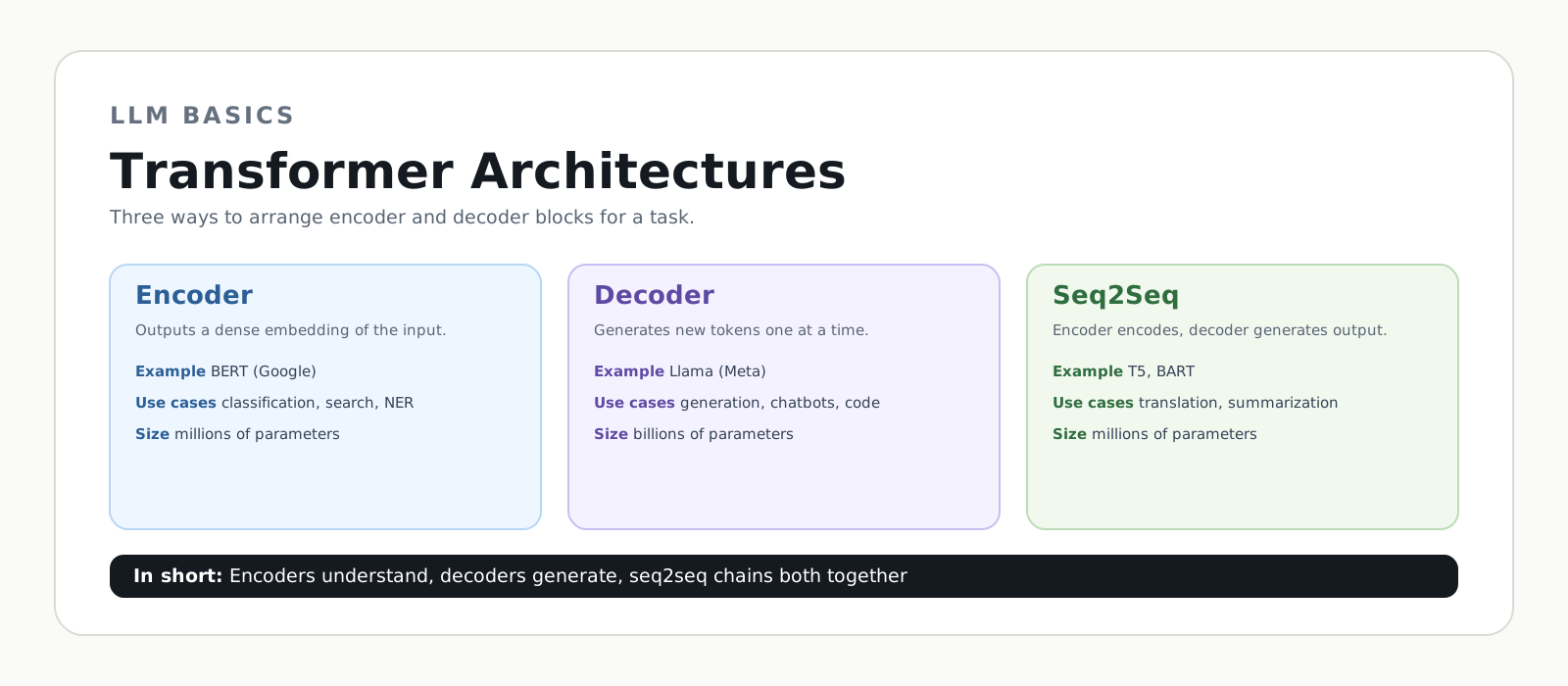
Encoders An encoder-based Transformer takes text (or other data) as input and outputs a dense representation (or embedding) of that text.
- Example: BERT from Google
- Use Cases: Text classification, semantic search, Named Entity Recognition
- Typical Size: Millions of parameters
-
Decoders A decoder-based Transformer focuses on generating new tokens to complete a sequence, one token at a time.
- Example: Llama from Meta
- Use Cases: Text generation, chatbots, code generation
- Typical Size: Billions (in the US sense, i.e., 10^9) of parameters
-
Seq2Seq (Encoder-Decoder) A sequence-to-sequence Transformer combines an encoder and a decoder. The encoder first processes the input sequence into a context representation, then the decoder generates an output sequence.
- Example: T5, BART
- Use Cases: Translation, Summarization, Paraphrasing
- Typical Size: Millions of parameters
Chat With Model
Message: While chatting with the model, the previous exchanged messages will be concatenated and formatted into a prompt that the model can understand.
Multimodal Chat Templates
Multimodal chat models accept inputs like images, audio, or video, in addition to text.
- Multimodal: one model that handles different types of input — text, image, audio, video. e.g. GPT-4o takes both images and speech. VLM (vision-language model) is the image+text subset.
- Multi-model: a system that uses several models together. e.g. RAG — an encoder retrieves the documents, a decoder writes the answer.
Special Tokens
Special tokens are reserved tokens used to communicate structural or control information to a model. Unlike ordinary tokens, they usually do not represent words or their normal lexical meanings. They help the tokenizer and model identify boundaries, padding, missing words, speaker roles, or special instructions. Common special tokens include:
[BOS]/<s>— Beginning of Sequence. Marks the beginning of the input sequence.[EOS]/</s>— End of Sequence. Marks the end of a sequence. During generation, producing this token may tell the model to stop.
Tool
AI Tool: An executable process or external API that allows agents to perform specific tasks and interact with external environments. The framework asks the LLM to generate tool invocation code when appropriate, and runs the tools on behalf of the model.
@tool
def calculator(a: int, b: int) -> int:
    """Multiply two integers."""
    return a * b

print(calculator.to_string())
Model Context Protocol (MCP): A Unified Tool Interface
Model Context Protocol (MCP) is an open protocol that standardizes how applications provide tools to LLMs.
Agent Workflow
Cycle: thinking (Thought) → acting (Act) and observing (Observe)
- Thought: internal reasoning
- Action: tool usage
- Observation: receiving tool output
Types of Agent Actions
| Type of Agent | Description |
|---|---|
| JSON Agent | The Action to take is specified in JSON format. |
| Code Agent | The Agent writes a code block that is interpreted externally. |
| Function-calling Agent | It is a subcategory of the JSON Agent which has been fine-tuned to generate a new message for each action. |