Malicious IP Detection
Requirements, QPS estimation, a hot/cold path split, and three deep dives: Bloom filter sizing, blacklist propagation, and layered detection.
"Design a system that detects and blocks malicious IPs" is a compact interview question that touches request-path latency, streaming pipelines, and probabilistic data structures in one design. This post walks through it the way I would answer it live.
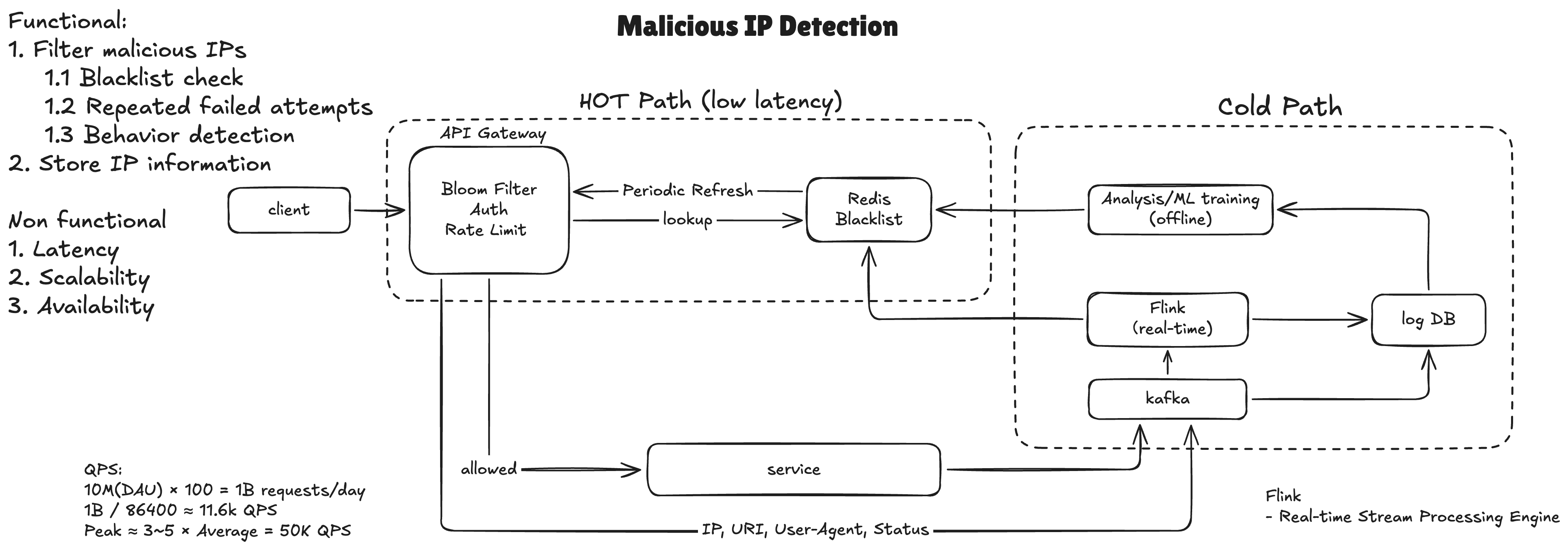
Requirements
Functional
- Filter malicious IPs, escalating in sophistication:
- Blacklist check — block IPs already known to be bad.
- Repeated failed attempts — detect brute force (many failed logins from one IP in a window).
- Behavior detection — catch patterns no single rule expresses: scraping cadence, unusual URI sequences, odd user agents.
- Store IP request information for analysis and audit.
Non-functional
- Latency — the check sits in front of every request, so its budget is a few milliseconds at most.
- Scalability — it must survive the traffic it is protecting against, including spikes.
- Availability — the filter failing must not take the product down with it.
Estimation
With 10M DAU making ~100 requests each:
10M × 100        = 1B requests/day
1B / 86,400      ≈ 11.6k QPS average
peak ≈ 3–5×      ≈ 50k QPS
Two conclusions fall out of the numbers. First, 50k QPS means the blocking decision cannot involve a database or any per-request fan-out — it has to be answered from memory. Second, 1B request logs per day means the analysis workload is a streaming problem, not something you bolt onto the request path.
Those two conclusions are the architecture: a hot path that only reads, and a cold path that does all the thinking.
High-level design
Hot path (low latency). The API gateway runs a Bloom filter, auth, and rate limiting in-process. On each request it checks the client IP against the Bloom filter; only on a hit does it confirm against the Redis blacklist. Allowed traffic proceeds to the service. The blocking decision costs a local memory lookup in the common case.
Cold path (all the analysis). The gateway and service asynchronously emit request metadata — IP, URI, User-Agent, status code — to Kafka. From there the stream splits:
- Flink consumes in real time and evaluates windowed rules (failed-attempt counting, request-rate anomalies), writing offenders straight into the Redis blacklist within seconds.
- A log DB stores the raw stream for offline analysis and ML training, which discovers slower patterns and periodically refreshes the blacklist with model-driven detections.
The design's core trade is explicit: the hot path is dumb and fast, the cold path is smart and slow, and the Redis blacklist is the only meeting point between them.
Deep dive 1: why a Bloom filter in front of Redis
At 50k QPS, even a 1ms Redis round-trip per request is 50 network calls per millisecond of aggregate budget — and the overwhelming majority of traffic is innocent. A Bloom filter answers "definitely not blacklisted" from gateway-local memory in nanoseconds.
The false-positive direction is what makes it safe here. A Bloom filter never says "no" incorrectly, so a clean verdict is trustworthy and skips Redis entirely. A "maybe" (false-positive rate ~1%) just costs one confirming Redis lookup — a wrong answer is never served, only occasionally a slightly slower one.
Sizing is cheap: 10M blacklisted IPs at 1% false-positive rate needs about 10 bits per entry — roughly 12 MB — trivially replicated to every gateway instance. The filter is rebuilt on the periodic refresh cycle; because Bloom filters don't support deletion, unbanning an IP takes effect at the next rebuild, which is an acceptable staleness for this direction (slightly over-checking, never under-blocking).
Deep dive 2: blacklist propagation
New detections must reach the hot path. Two mechanisms cover the two urgency classes:
- Write-through for real-time detections. Flink writes offenders directly into Redis. The next confirming lookup sees them immediately — the Bloom filter may miss until rebuild, so gateways treat filter and recent-writes correctly by letting Flink also publish a small "recent bans" delta the gateways poll or subscribe to.
- Periodic refresh for the bulk set. Gateways rebuild the Bloom filter (and warm local caches) from the full Redis set on an interval — say every 1–5 minutes.
The consistency question an interviewer will probe: how long between attack and block? Failed-attempt rules take effect in seconds via the write-through path; ML-driven detections take effect on the refresh interval. Both are eventual, and that's fine — the requirement is protecting the aggregate, not blocking request #1.
Entries should carry TTLs. Permanent bans accumulate stale IPs (addresses get reassigned), inflate the Bloom filter, and raise the false-positive rate for innocent users who inherit a banned address.
Deep dive 3: layered detection
The three functional requirements map onto three timescales, and each lives where its latency budget allows:
| Layer | Where | Reaction time | Example |
|---|---|---|---|
| Known-bad lookup | Hot path (Bloom + Redis) | per request | blacklisted IP |
| Windowed rules | Flink | seconds | 20 failed logins / 60s from one IP |
| Learned behavior | Offline ML on log DB | hours | scraping disguised as browsing |
The layering also fixes each layer's weakness: rules catch what the blacklist hasn't seen, ML catches what rules can't express, and everything ML learns is distilled back into the cheap layers — a model score becomes a blacklist entry, a discovered pattern becomes a new Flink rule. Detection intelligence flows down; per-request cost stays flat.
Availability: fail open or fail closed?
The classic probe: Redis is down — do you block everyone or admit everyone?
For this system, fail open: the gateway skips the confirming lookup and serves traffic using the last-built Bloom filter and rate limiting alone. A few minutes of degraded filtering is strictly better than a self-inflicted outage — the filter exists to protect availability, so it must not become the availability risk itself. The mitigations are already in the design: the Bloom filter keeps working from local memory with no dependency, per-IP rate limiting still bounds abuse, and Kafka retains the stream so the cold path replays and catches up once Redis returns.
The opposite choice is defensible for high-stakes surfaces (payments, admin endpoints) — which is exactly the nuance worth saying out loud in an interview: fail-open vs fail-closed is a per-endpoint policy, not a global constant.