Pub/Sub + Cloud Run: Async Pipeline
A practical note on GCP Pub/Sub, Cloud Run, ack/retry semantics, DLQ, idempotent consumers, and the AWS SNS/SQS/Lambda mapping.
Pub/Sub is an asynchronous messaging middleware. It lets producers avoid calling consumers directly: producers publish work to a Topic, and a Subscription controls how that message is delivered to a Consumer.
The core shift is:
System A -> Topic -> Subscription -> System BThis makes systems more decoupled, more resilient, and easier to scale. For a backend engineer, the important part is not memorizing one API. The important part is understanding async architecture, retry semantics, idempotency, DLQ, and eventual consistency.
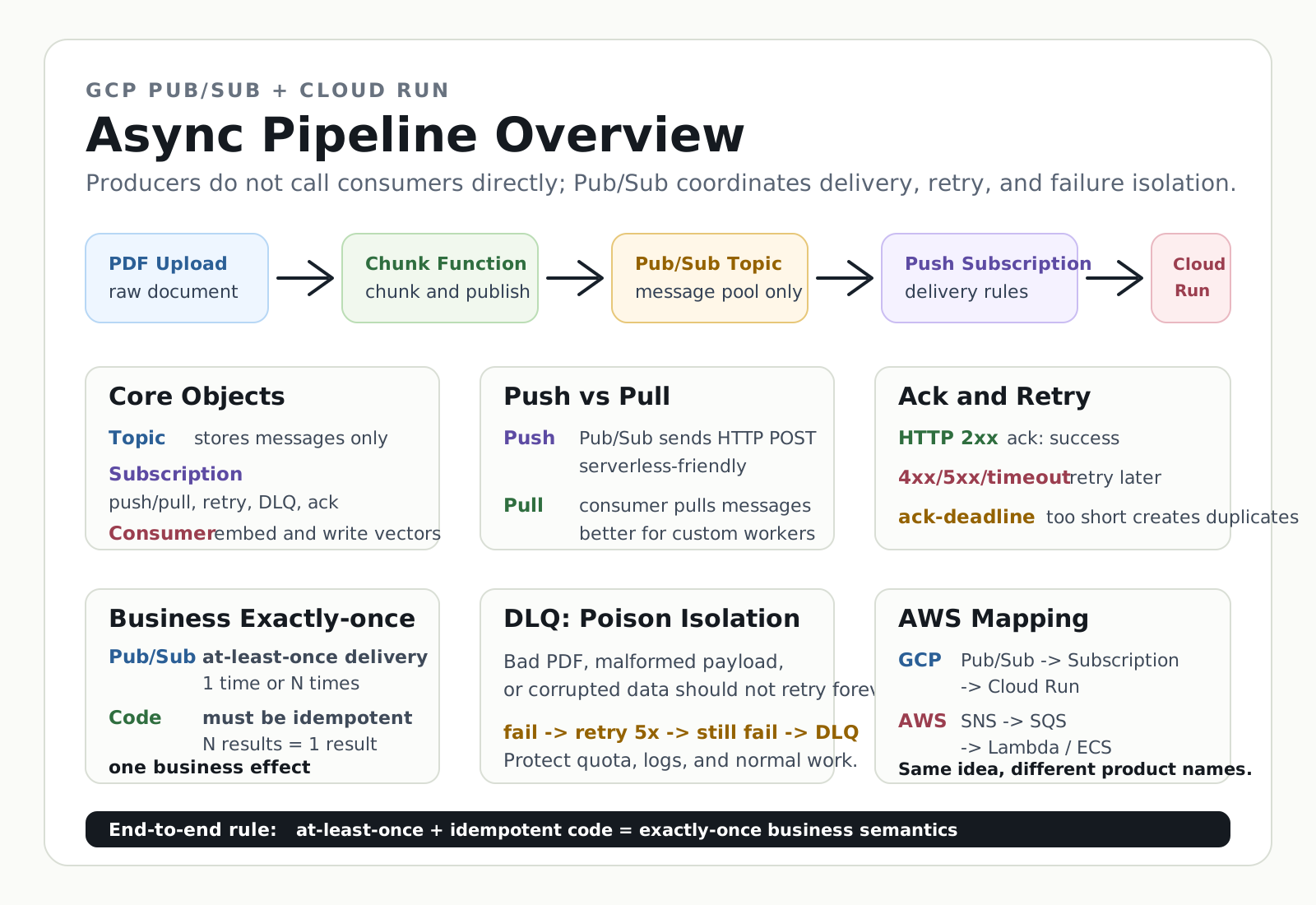
RAG Pipeline Mental Model
A typical asynchronous RAG pipeline can be split like this:
PDF Upload
    ↓
Chunk Function
    ↓ publish
Pub/Sub Topic
    ↓ push delivery
Vectorizer Cloud Run / Function
    ↓
Vertex AI Embedding
    ↓
Supabase pgvector
The responsibilities are:
| Component | Role |
|---|---|
| Chunk Function | Splits the PDF into chunks and creates vectorization tasks |
| Topic | Receives and stores messages temporarily |
| Subscription | Defines delivery mode, push/pull, retry, DLQ, and ack deadline |
| Vectorizer | Processes messages, calls Vertex AI, and writes to pgvector |
| pgvector | Stores embeddings for semantic retrieval |
Topic, Subscription, Consumer
Topic is the message entry point. After a producer calls publisher.publish(topic, data), it has handed the message to Pub/Sub. The Topic itself does not run business logic.
Subscription defines how messages are consumed, including who receives them, whether delivery is push or pull, and rules such as ack deadline, retry policy, and DLQ. One Topic can have multiple Subscriptions, so the same event can be consumed independently by multiple downstream systems.
Consumer is the service that actually does the work. In this example, the Vectorizer Consumer receives a chunk message, calls Vertex AI to generate an embedding, and writes the result into Supabase pgvector.
Push vs Pull
In pull mode, the Consumer actively pulls messages:
while True:
    msg = subscriber.pull()
The mental model is picking up a package yourself. The main benefit is that the consumer controls pacing, which is useful for complex workers. The cost is that you must maintain the polling loop and worker infrastructure.
In push mode, Pub/Sub sends an HTTP POST to Cloud Run or Cloud Functions:
Pub/Sub -> HTTP POST -> Cloud RunThe mental model is delivery to your door. Push is more serverless-friendly because Cloud Run only needs to expose an endpoint, while Pub/Sub handles delivery.
Ack, Ack Deadline, Retry
Ack means: "I processed this successfully."
In a Push Subscription:
| HTTP result | Pub/Sub interpretation |
|---|---|
2xx |
ack, message processed successfully |
4xx / 5xx / timeout |
nack or no ack, message may be redelivered |
So a Cloud Run handler often has this basic shape:
try:
    process()
    return "ok", 200
except Exception:
    raise
ack-deadline is the time window Pub/Sub waits for an ack. For example, --ack-deadline=60 means the consumer must confirm within 60 seconds. If processing is too slow or the network breaks, Pub/Sub may assume the consumer failed and redeliver the message.
This leads to the most important production fact: Pub/Sub defaults to at-least-once delivery. A message is delivered at least once, but it may be delivered multiple times.
Why Idempotency Matters
Consumers must be idempotent because duplicate delivery is normal, not a bug.
For example:
UPDATE documents
SET status = 'done'
WHERE id = 1;
Running this multiple times leaves the same final state. This is an idempotent operation.
But this operation is not idempotent:
UPDATE wallet
SET balance = balance + 100;
If the same message is processed twice, the amount is added twice.
A common duplicate-delivery scenario is:
- the consumer already wrote to the database
- the network failed before it returned
200 - Pub/Sub did not receive the ack
- Pub/Sub redelivered the same message
Therefore, the application layer should use tools like event_id, unique constraints, state machines, upserts, or deduplication tables to make duplicate processing harmless.
Delivery Guarantee vs Business Semantics
This relationship is critical: delivery guarantee is not the same as business semantics.
Pub/Sub gives you: at-least-once delivery
                   it may deliver 1 time or N times
              ↓
Your code must be: idempotent
                   processing N times must equal processing 1 time
              ↓
Together:          end-to-end exactly-once business semantics
Pub/Sub can provide reliable delivery, but it cannot automatically make your business code idempotent. Idempotency must be implemented in the application layer.
The more precise statement is: at-least-once delivery + idempotent consumer = exactly-once business effect.
at-least-once delivery + idempotent consumer
= exactly-once business effect
In other words, the messaging layer may duplicate delivery, but the business effect must not be duplicated.
DLQ: Dead Letter Queue
DLQ is a poison-message isolation area. Some messages can never be processed, such as bad PDFs, malformed payloads, missing fields, or corrupted data.
Without a DLQ, Pub/Sub may keep retrying forever, wasting quota, creating noisy logs, and slowing down healthy work.
A typical production configuration is:
gcloud pubsub subscriptions create pdf-vectorizer-sub \
  --topic=pdf-chunks-topic \
  --push-endpoint=https://vectorizer.run.app \
  --ack-deadline=60 \
  --max-delivery-attempts=5 \
  --dead-letter-topic=pdf-chunks-dlq
The workflow is:
normal message
    ↓
failure
    ↓
retry 5 times
    ↓
still fails
    ↓
move to DLQ
Why Not Rely On Exactly Once
In production, the common choice is at-least-once + idempotent consumer, rather than relying only on message-system-level exactly-once.
The reason is that exactly-once is more complex, may reduce throughput, and often comes with more constraints. Even if the message system provides exactly-once delivery, the application still has to handle idempotency when writing to a database, calling external APIs, or updating business state.
The practical engineering rule is:
- the messaging system handles reliable delivery and retries
- the consumer handles idempotent processing
- DLQ isolates messages that keep failing
- monitoring catches backlog, failure rate, retry storms, and DLQ growth
GCP And AWS Mapping
GCP and AWS solve the same class of cloud-native backend problems. The product names are different, but the architecture is similar.
| Concept | GCP | AWS |
|---|---|---|
| Serverless compute | Cloud Run / Cloud Functions | Lambda / ECS Fargate / App Runner |
| Message queue / pub-sub | Pub/Sub | SNS + SQS |
| Object storage | Cloud Storage | S3 |
| Machine identity | Service Account | IAM Role |
| Secrets | Secret Manager | Secrets Manager / SSM |
| Logs | Cloud Logging | CloudWatch |
A common GCP flow is:
Pub/Sub Topic -> Push Subscription -> Cloud RunIn AWS, the equivalent is often:
SNS Topic -> SQS Queue -> Lambda / ECS WorkerOr:
S3 Event -> SNS -> SQS -> LambdaThe difference is that GCP Pub/Sub combines Topic and Subscription more tightly, while AWS usually separates fanout and queue buffering into SNS + SQS. The underlying idea is the same: the producer does not call the consumer directly. It hands work to a messaging system, the consumer processes asynchronously, failures retry automatically, and poison messages go to a DLQ.
Interview Takeaways
- Why Pub/Sub: decoupling, async processing, higher throughput, and better reliability.
- Why DLQ: prevent poison messages from retrying forever and protect quota, logs, and healthy work.
- Why consumers must be idempotent: message duplication is normal in distributed systems.
- How to get exactly-once business effect: the messaging system provides
at-least-once delivery, while application code providesidempotency. - What happens if
ack-deadlineis too short: slow requests may be misclassified as failures, causing duplicate processing. - Push vs Pull: Push fits Cloud Run-style serverless endpoints; Pull fits workers that need their own pacing.
- The production model:
at-least-once delivery + idempotent consumer + retry policy + DLQ + monitoring.