Inside a RAG Agent: Runtime, Memory, Tools, and Retrieval
Five design boundaries inside a LangGraph RAG agent: control flow, safety and tools, retrieval compatibility, checkpointed memory, and session isolation.
This agent becomes easier to understand when the implementation is reduced to five boundaries: control flow, safety and tool contracts, retrieval compatibility, checkpointed memory, and session isolation.
The implementation is a LangGraph RAG chat agent built around Gemini, Vertex AI embeddings, Supabase/pgvector, and LangGraph checkpointing. The important part is not any one library. It is how these parts divide responsibility.
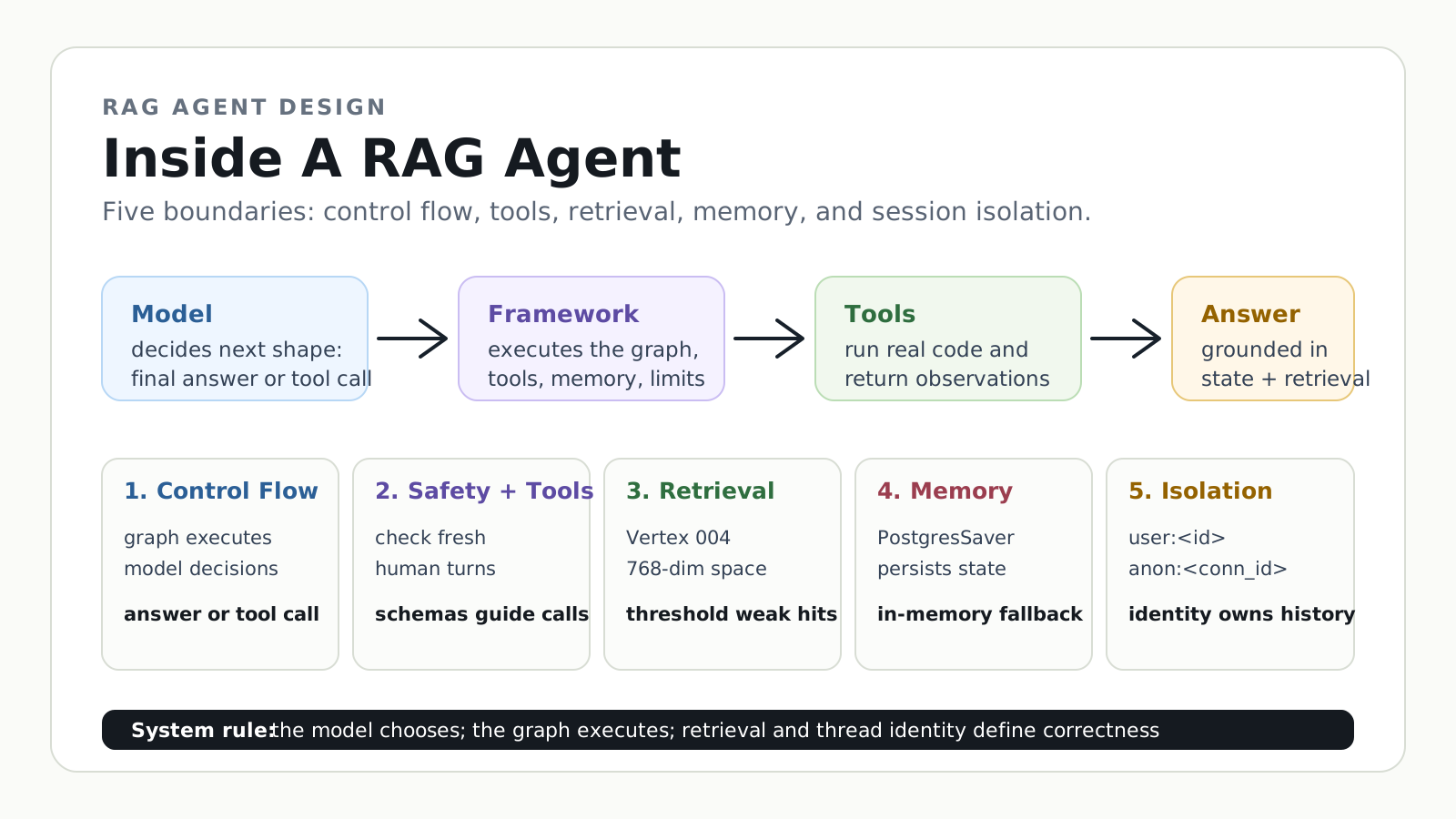
1. The Graph Controls Execution; The Model Chooses The Path
The request enters through run_agent, which resolves a thread, creates a HumanMessage, and calls graph.invoke.
run_agent(text, user_id, conn_id)
    -> graph.invoke
    -> assistant
       -> tool call? -> tools -> assistant -> ...
       -> final answer? -> END
The graph contains only two nodes:
builder.add_node("assistant", assistant)
builder.add_node("tools", ToolNode(tools))

builder.add_edge(START, "assistant")
builder.add_conditional_edges("assistant", tools_condition)
builder.add_edge("tools", "assistant")
The important design choice is that retrieval is not hard-coded into every request. The LLM receives bound tool definitions and decides whether it needs search_supabase. LangGraph's tools_condition inspects the response: a tool call continues the loop, while a normal answer ends it.
The model decides what should happen next. The graph decides how that decision is executed.
2. Safety And Tool Descriptions Are Part Of The Agent Contract
The assistant node performs a safety check only when the newest message is a fresh HumanMessage:
if isinstance(last_message, HumanMessage):
    dangerous, irrelevant, personal = prompt_check(last_message.content)
    if dangerous or personal or irrelevant:
        return {"messages": [AIMessage(content="I'm sorry, I can't answer that question.")]}
This placement matters. Tool results and prior AI messages should not be reinterpreted as new user input.
The tools are then bound to Gemini:
tools = [search_supabase, log_gap]
llm_with_tools = llm.bind_tools(tools)
For tool-calling agents, function names, parameter names, and docstrings are model-facing instructions. The search_supabase docstring becomes part of the tool schema that Gemini sees. Tool design is therefore partly API design and partly prompt design.
There is also an explicit temporary constraint: log_gap is disabled because its table still stores 384-dimensional vectors while the current query embeddings are 768-dimensional. Returning a controlled message is safer than writing incompatible vectors.
3. Retrieval Has A Strict Embedding Contract
The retrieval path is:
search_supabase(query)
    -> Vertex text-embedding-004
    -> 768-dimensional RETRIEVAL_QUERY vector
    -> match_document_sections RPC
    -> cosine KNN + priority rerank
    -> similarity threshold
    -> relevant chunks or "I do not know"
The most important rule is: query embeddings and document embeddings must live in the same vector space.
The corpus was embedded with Vertex AI text-embedding-004, 768 dimensions, using the document retrieval task type. The query must therefore use:
types.EmbedContentConfig(
    task_type="RETRIEVAL_QUERY",
    output_dimensionality=768,
)
Switching the query side to an AI Studio embedding model would not be an interchangeable upgrade. It would produce a different vector space, making similarity scores meaningless even if the dimensions happened to match.
The code also separates two authentication paths:
- Gemini generation uses
GEMINI_API_KEY. - Vertex embeddings use
GCP_SA_JSONin production or Application Default Credentials locally.
After retrieval, a 0.6 similarity floor filters weak results. If no chunk passes, the tool returns "I do not know the answer" rather than grounding the LLM on noisy context.
4. Conversation Memory Belongs To The Checkpointer
The assistant node does not manually load or save chat history:
def assistant(state):
    messages = state["messages"]
    ...
History is injected by the checkpointer compiled into the graph:
graph = builder.compile(checkpointer=checkpoint_saver)When SUPABASE_DB_URL is available, the agent uses LangGraph's official PostgresSaver over Supabase Postgres. Its setup creates the checkpoint tables and LangGraph persists state around every invocation.
checkpoint_saver = PostgresSaver(connection)
checkpoint_saver.setup()
Without a database URL, the application falls back to InMemorySaver. That keeps local development working, but memory becomes ephemeral and disappears when the process restarts.
This is a clean separation of concerns: nodes implement behavior; the runtime implements persistence.
5. Thread IDs Define Session Isolation
Checkpointed memory is only safe if each conversation receives the correct thread_id.
def resolve_thread_id(user_id, conn_id):
    if user_id and str(user_id).strip().lower() not in ANON_SENTINELS:
        return f"user:{str(user_id).strip()}"
    return f"anon:{conn_id}"
The policy is:
- authenticated users receive a stable
user:<id>thread - anonymous visitors receive an
anon:<conn_id>thread scoped to one WebSocket connection - values such as
"","anon","null", and"undefined"are treated as anonymous sentinels rather than shared identities
This prevents anonymous users from collapsing into one shared conversation history.
There is still a separate production concern: until the backend verifies an authentication token, a client-supplied user_id can be spoofed. Thread resolution provides isolation only when the identity feeding it is trustworthy.
The conn_id must also be generated once per WebSocket connection, not once per message. If it changed every turn, anonymous users would lose multi-turn memory.
The System In One Sentence
The model chooses whether to answer or retrieve; LangGraph executes the loop; Vertex and pgvector enforce the retrieval contract; the checkpointer persists state; and thread_id determines who owns that state.