URL Shortener
Requirements, short code generation strategies, caching, and scaling reads and writes with separate read/write services.
Question
Bit.ly is a URL shortening service that converts long URLs into shorter, manageable links.
ie. www.mylongurl.com/long/is/annoying -> www.bit.ly/GHJ23
Answer
Functional Requirements
- Users can create a short url from a long url
- optionally support custom alias
- optionally support an expiration time
- Users can be redirected to the original url from the short url
Non-Functional Requirements
- Low latency on redirects (~200ms)
- Scale to support 100M DAU and 1B urls
- Ensure uniqueness of short code
- High Availability: redirects remain accessible (CAP)
Core Entities
- Original url
- Short url
- User
API
// shorten a url
POST /urls -> shortUrl
{
  originalUrl,
  alias?,
  expirationTime?
}

// redirection
GET /{shortUrl} -> Redirect to OriginalUrl
High-level Design
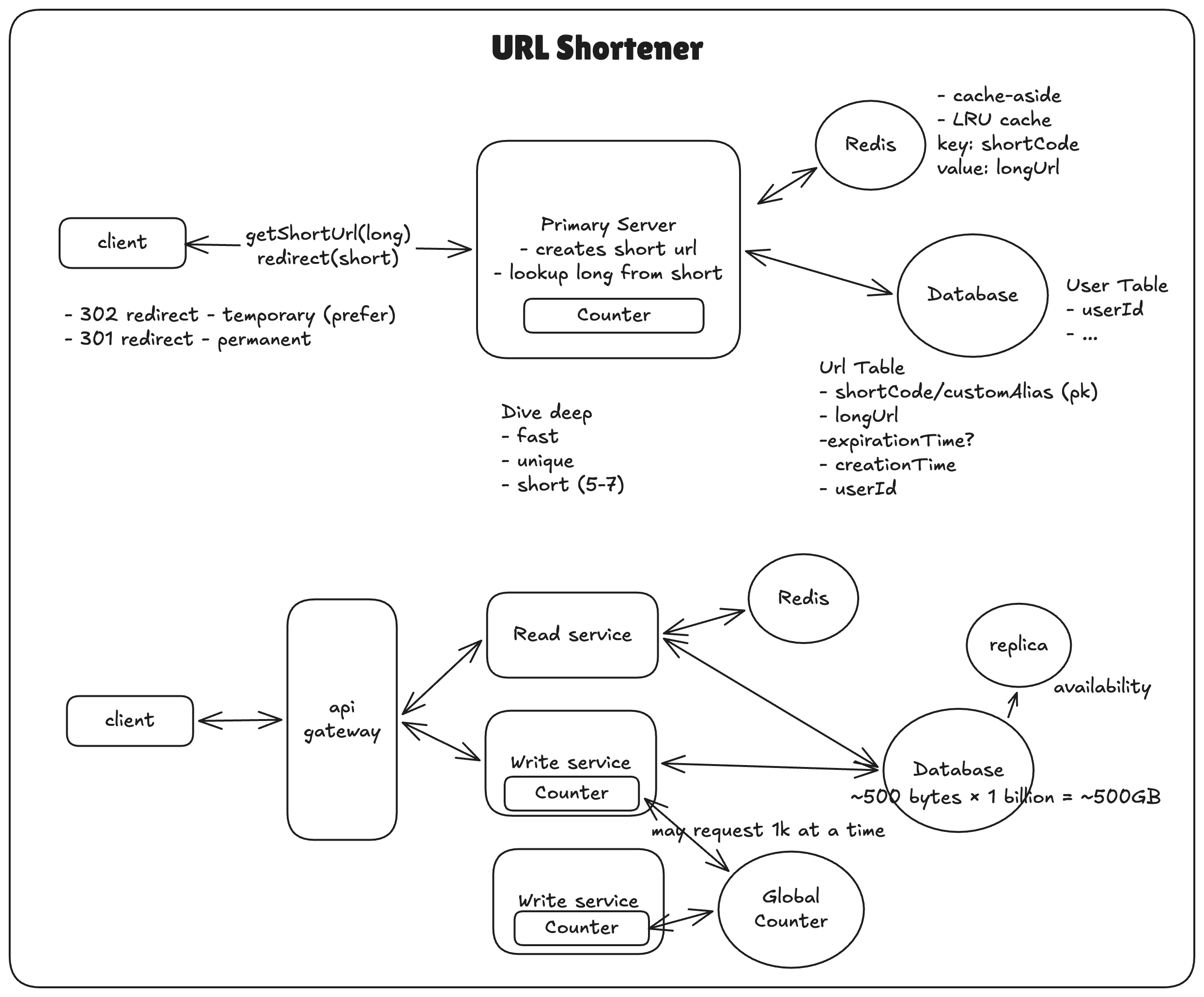
Dive Deep
Functional
- fast
- unique
- short (5-7)
System-generated short code
- prefix of the long url
- two different long URLs commonly share a prefix
- random number generate (1B url, 1,000,000,000)
- base62 encoding, characters: 0-9, A-Z, a-z
- 62^6 = 56B
- collision happen
- -> we need to check for collision first
- Hash the long url
- hash function: MD5 (long URL)
- 128-bit hash (32 hex characters), characters: 0-9, a-f
- base62(hash), characters: 0-9, A-Z, a-z
[:6]- -> we need to check for collision first
- Counter
- incrementing a counter -> base62
- predictability which is bad for security
- "Warning, shorten private urls"
- rate liming
Non-functional
Low latency
- add cache (redis)
Scale
- DAU 10^8 / 10^5 = 10^3 pre second
- peak:
*10 or *100= 10k - 100k rps
- peak:
- Scale horizontally
- read need to scale
- Microservice
- read service talks to Redis first, falling through to the database on a cache miss
- write service owns short-code creation.
- Database scale
URL Table:
  - shortCode / customAlias (PK): ~8 bytes
  - longUrl: ~100 bytes
  - expirationTime: ~8 bytes
  - creationTime: ~8 bytes
  - userId: ~8 bytes
~ 500bytes * 1B = 500 bytes * 10^9 url = 500 GB
High Availability
- replication + failover + redundancy
- The database has a replica for read availability