Distributed Data Parallel
A compact visual guide to DDP: full model copies, per-GPU batches, gradient all-reduce, NCCL, and when Forge should use DDP versus FSDP.
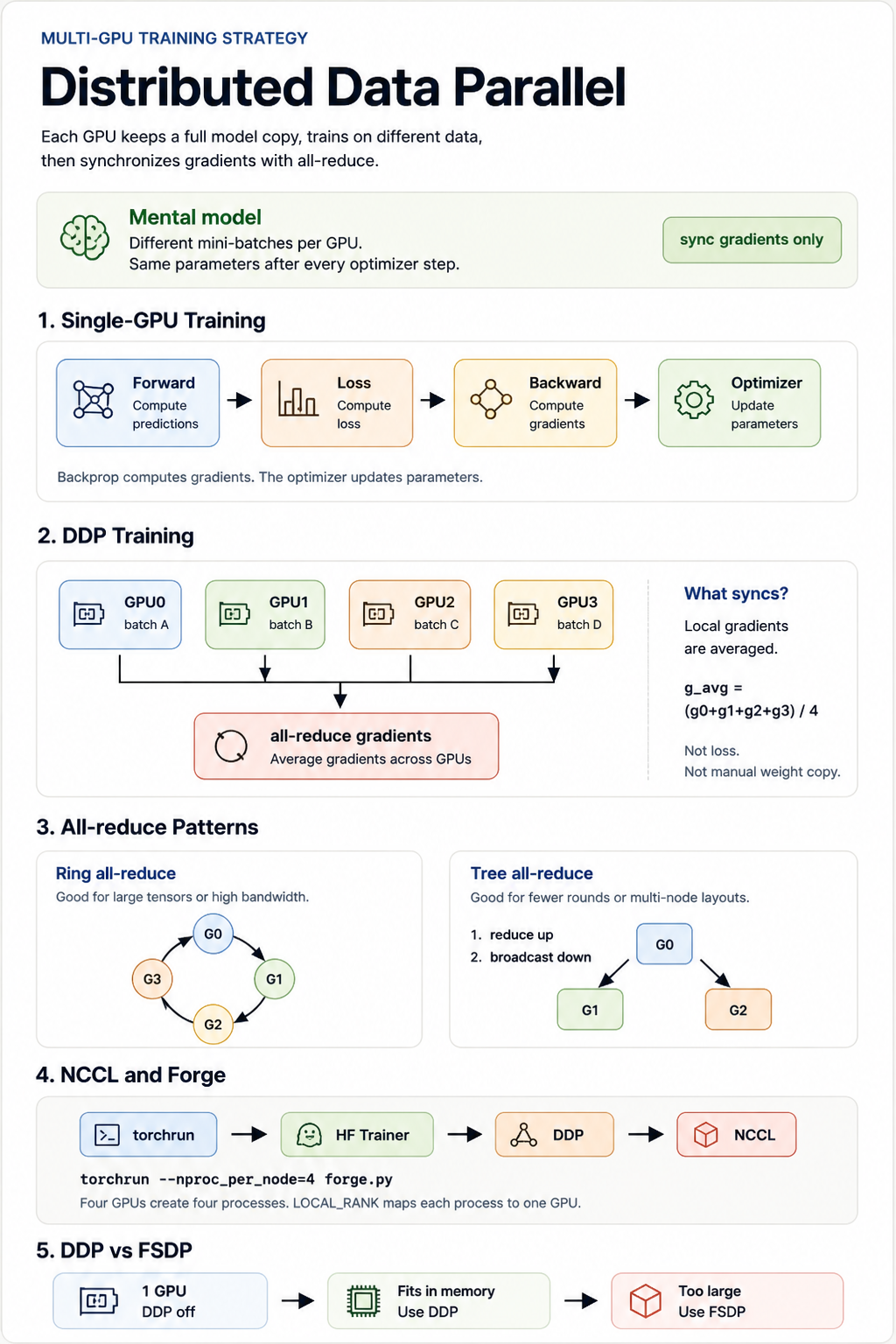
This poster summarizes Distributed Data Parallel as a multi-GPU training pattern: every GPU keeps a full model copy, processes different data, computes local gradients, and uses all-reduce so every process applies the same averaged update.
1. What is DDP?
Distributed Data Parallel (DDP) is a multi-GPU training strategy.
Each GPU keeps a full copy of the model, processes a different mini-batch, computes gradients locally, and synchronizes gradients across GPUs using all-reduce.
Each GPU trains on different data, but all GPUs keep the same model parameters via gradient synchronization.
2. Single-GPU Training Flow
1. Initialize
   Initialize weights (w) and bias (b)

2. Forward pass
   z = wx + b

3. Compute loss
   loss = Loss(z, y)

4. Backward pass
   Compute gradients:
   dLoss/dw
   dLoss/db

5. Optimizer step
   w = w - lr * dLoss/dw
   b = b - lr * dLoss/db

6. Repeat
   Repeat for steps and epochs
Key points:
- Backpropagation only computes gradients
- Optimizer updates parameters
- 1 epoch = one full pass through dataset
3. DDP Training Flow
1. Initialize
   Each GPU has a full model copy

2. Data split
   Each GPU gets a different mini-batch

3. Forward pass (per GPU)

4. Compute loss (per GPU)

5. Backward pass (per GPU)
   Compute local gradients

6. Gradient synchronization
   All-reduce gradients

7. Optimizer step
   Use averaged gradients

8. Repeat
DDP synchronizes gradients, not loss or weights.
4. What is All-reduce?
All-reduce aggregates values from all GPUs and returns the result to every GPU.
Example:
g_avg = (g0 + g1 + g2 + g3) / 4Each GPU gets the same gradient -> same model update
5. All-reduce Implementations
5.1 Ring All-reduce
GPU0 -> GPU1 -> GPU2 -> GPU3 -> GPU0- Pass gradient chunks around
- Accumulate while passing
Good for:
- Large gradient tensors
- High bandwidth efficiency
- No central bottleneck
5.2 Tree All-reduce
        GPU0
       /    \
    GPU1    GPU2
Steps:
1. Reduce (bottom -> top)
2. Broadcast (top -> bottom)
Good for:
- Fewer communication rounds
- Smaller messages / multi-node
5.3 Summary
Ring -> circle communication
Tree -> hierarchical communication
No single best choice -> depends on hardware & data size
6. NCCL in DDP
NCCL = NVIDIA Collective Communications Library
Used by PyTorch DDP for GPU communication.
DDP -> uses NCCL
NCCL -> executes all-reduce
You do NOT implement ring/tree manually.
7. Why DDP > DataParallel
DataParallel:
main GPU handles everything -> bottleneckDDP:
one process per GPU
local compute + all-reduce
Advantages:
- no single-process bottleneck
- lower Python overhead
- faster GPU communication
- overlap communication with backward
8. How Forge Uses DDP
Forge does NOT manually write:
torch.nn.parallel.DistributedDataParallel(...)Instead:
torchrun / SLURM
    ↓
multiple processes
    ↓
Hugging Face Trainer
    ↓
automatic DDP
    ↓
NCCL all-reduce
Single-node multi-GPU
torchrun --nproc_per_node=4 forge.py-> 4 GPUs = 4 processes
Multi-node multi-GPU
multiple machines
each runs torchrun
all processes connect
LOCAL_RANK
Each process uses its own GPU:
LOCAL_RANK=0 -> cuda:0
LOCAL_RANK=1 -> cuda:1
...
9. DDP vs FSDP (Forge)
Strategy:
1 GPU -> off
fit in memory -> DDP
too large -> FSDP
Difference:
DDP -> full model on each GPU
FSDP -> model sharded across GPUs